Slow Psychedelics
Reclaiming Ceremony, Reciprocity & Regeneration in the Psychedelic-Assisted Therapy Era

By Helen Loshny, MA, RTC Co- Founder, Empower Health Wellness Centre (Vancouver, BC)
Why "Slow" Matters to Me
I've spent more than 15 years at the crossroads of regulation, clinical practice governance, and holistic wellness entrepreneurship. I've been building systems that try to honour the human spirit while also satisfying oversight bodies, scopes of practice, and risk management realities. Over that time I've watched promising healing modalities get distorted when they scale too fast, or when commerce outruns care.
This work is also deeply personal. My family has lived through the opioid and fentanyl crisis. My daughter's recovery journey, still unfolding, has been supported by a multidisciplinary care web that included ketamine-assisted therapy within a structured therapeutic container. Our story is part of a documentary now in development exploring recovery, family systems, and the future of psychedelic-assisted approaches. I share this not to market a medicine, but to say: for many of us, the stakes are real and urgent.
Recently I spoke with a Yoruba technologist using Web3 + AI to power "slow fashion." She was tracking every step of a textile's life and routing fair compensation back to the artisans who weave and dye by hand. That conversation lit up a parallel question: What if we brought the same values to psychedelic-assisted therapy? Traceability, reciprocity, cultural respect, ecological care. Could we imagine Slow Psychedelics?
Why "Slow" Matters Now
The psychedelic space is expanding fast. Clinical research has advanced on compounds such as MDMA for PTSD, psilocybin-assisted psychotherapy for depression and end-of-life distress, and renewed clinical interest in ketamine. Yet rapid growth brings growing pains: commercialization pressures, regulatory complexity, uneven access, and tensions around cultural and ecological stewardship.
Commercial & Regulatory Whiplash
Hopes were high that MDMA-assisted therapy would become the first broadly approved psychedelic intervention for PTSD in the U.S., following positive Phase 3 data. Regulators ultimately declined to approve the application, citing concerns about data integrity, study design, and safety monitoring. This signaled that integrating psychedelics into medical systems will be more complex than early headlines suggested.
Even with regulatory setbacks, MDMA research has shown clinically meaningful symptom reductions in PTSD across multiple Phase 3 trials. Notable proportions of participants no longer met diagnostic criteria after structured therapy protocols combining preparatory, dosing, and integration sessions. These trials helped define what "medicine + therapy container" can look like in practice. Yet the FDA's rejection appears to have been influenced by factors beyond scientific merit, including industry politics and coordinated opposition efforts that warrant broader examination.
The Canadian Landscape: Research, Caution & Access Pathways
In Canada, most classic psychedelics remain non-marketed and are accessed only through clinical trials or the federal Special Access Program (SAP). The SAP can authorize case-by-case use (not broad approval) when conventional treatments have failed and evidence supports potential benefit. Current SAP requests most often involve psilocybin or MDMA. Practitioners must meet stringent documentation, quality, and legal requirements under both the Food and Drug Regulations and the Controlled Drugs and Substances Act.
At the same time, ketamine (a dissociative anesthetic with psychedelic properties at certain doses) can be prescribed off-label and delivered within regulated medical practice. Many Canadian clinics, including ours, offer ketamine-assisted therapy (KAT) inside multidisciplinary care frameworks that include medical screening, preparation, dosing, and integration.
Communicating Slow Psychedelics Under Canadian Law
Health Canada draws a distinction between educational information and advertising, which they define broadly as any representation that promotes the sale or use of a health product. Promotional claims for unauthorized or prescription-only drugs directed to the public can trigger enforcement. Safer territory involves describing therapeutic approaches, research developments, and values frameworks without implying product availability, pricing, or disease-specific treatment claims tied to non-authorized substances.
The Six Principles of Slow Psychedelics
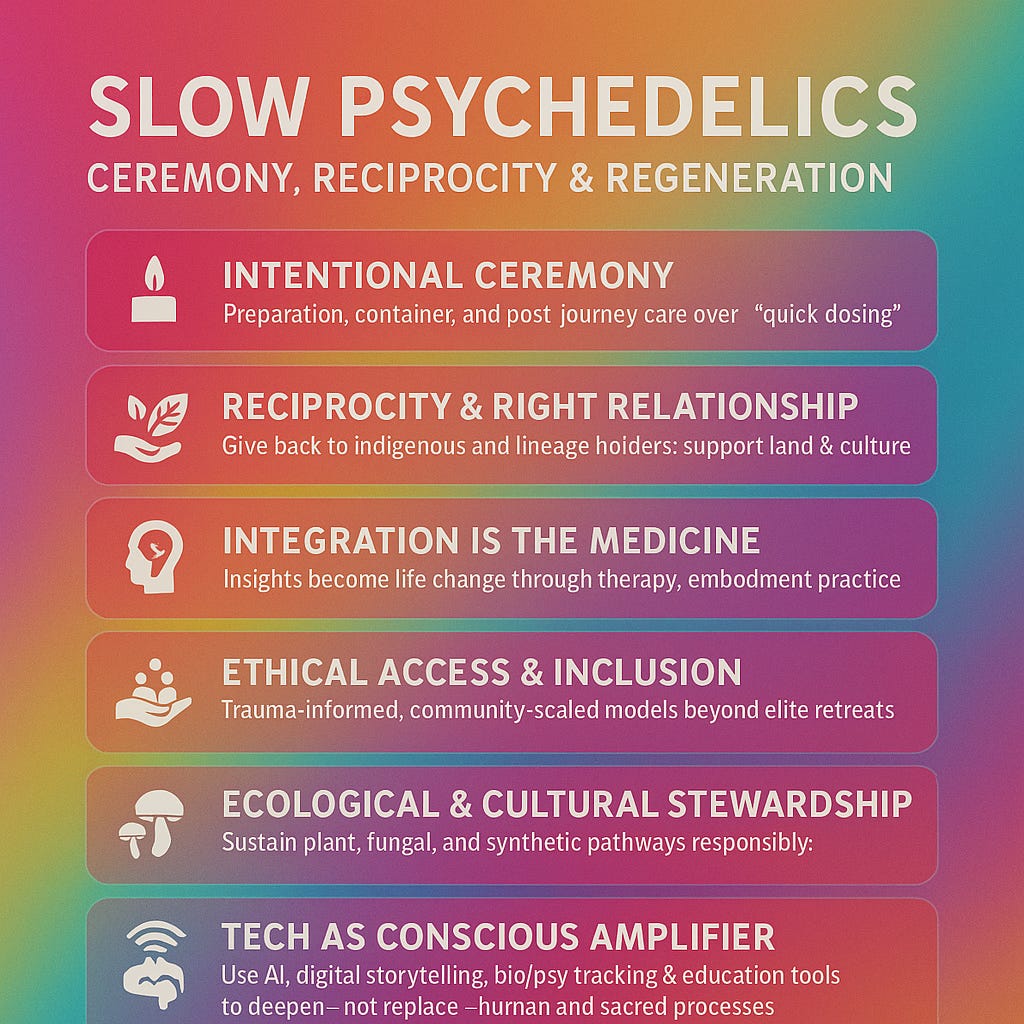
1. Intentional Ceremony
Slow Psychedelics privileges process over product. Whether in a licensed clinic, research protocol, or culturally rooted ceremony, outcomes improve when participants receive thorough preparation, a safe and skilled container during medicine sessions, and structured integration afterward. The MDMA Phase 3 programs (MAPP1/MAPP2) operationalized exactly this arc: multiple preparatory visits, monitored dosing sessions, and integration therapy. This contributed to significant PTSD symptom reductions and functional gains compared with therapy plus placebo.
2. Reciprocity & Right Relationship
Many psychedelic practices arise from Indigenous, lineage-based, or community stewarded traditions. Ethical participation calls for giveback pathways (financial, cultural, and ecological) and humility when engaging medicines that are not ours to commercialize. Current debates around peyote conservation and ayahuasca tourism illustrate what happens when external demand outpaces relationship: habitat pressure, poaching, cultural distortion, and spiritual commodification.
Community-led conservation initiatives, like Indigenous Peyote Conservation efforts, and Indigenous calls to protect ceremonial integrity point toward reciprocal models.
3. Integration Is the Medicine
Insight without integration rarely transforms a life. Clinical psychedelic protocols increasingly formalize post-session integration through psychotherapy, somatic practice, meaning-making, lifestyle shifts, and community support. The ketamine programs at Empower Health Wellness Centre, for example, emphasize individualized preparation and follow-up to help translate non-ordinary state experiences into sustained mental-health change. This mirrors integration scaffolds used in research and emerging clinical guidelines.

4. Ethical Access & Inclusion (and the Alberta Debate)
Access to psychedelic-assisted care has often been limited to those who can travel, pay out of pocket, or navigate boutique retreat models. This exacerbates inequities in mental-health outcomes. Alberta became the first Canadian province to build a licensing framework for psychedelic drug treatment services, requiring service standards, clinical oversight (including psychiatrist involvement), and facility quality controls.
Proponents argue regulation protects vulnerable patients in altered states. Critics caution that mandatory psychiatric oversight and licensing complexity may create bottlenecks, concentrate control in medicalized settings, and sideline community-based or culturally grounded models. This raises the question: When does "safety" tip into "over-medicalization"? This tension between safeguard and gatekeeping will shape policy far beyond Alberta.
5. Ecological & Cultural Stewardship
Narratives about "psychedelic demand is wiping out X plant" can be oversimplified; conditions vary by species and region. Still, peyote populations in Texas and Mexico face habitat loss, slow regrowth, and harvesting pressures, prompting conservation land purchases and education within the Native American Church. Meanwhile, ayahuasca tourism in Amazonian regions has drawn Indigenous criticism for cultural appropriation, environmental strain, and commodification of sacred symbols and wildlife.
Responsible practice means listening to local stewards, supporting cultivation where appropriate, limiting extractive travel models, and aligning benefits with community priorities.
6. Tech as Conscious Amplifier (Not Replacement)
Digital tools can lighten admin load and deepen care when guided by ethics. AI "ambient scribes" and note-assist platforms are now helping clinicians (solo practitioners and small group practices included) capture sessions, generate structured progress notes, and surface longitudinal patterns across language, affect, and clinical themes. This data-driven approach to treatment tracking enables evidence-based refinements that enhance future therapeutic outcomes. Early reports from health and behavioral care settings suggest time savings, improved documentation quality, and the ability to spot symptom or relational pattern shifts that might otherwise be missed. This requires that clinicians review, correct, and clinically interpret outputs.
Beyond documentation, sentiment and language analytics can support reflective practice. Tools drawing on natural language processing can flag tone changes, emotional intensities, or recurring cognitive frames. This proves useful for integration work and for helping clients track how new insights show up in day-to-day life and somatic patterns linked to thriving. As an example see this substack article that emerged from applying a simple language pattern analysis template to a client’s Ketamine Assisted Therapy session.
These systems are still evolving. Ethical deployment demands consent, privacy safeguards, cultural nuance, and a clear stance that AI augments (not replaces) the therapeutic relationship.
Creative and cultural uses matter too. Artists like Ari Kushnir are experimenting with AI-generated ceremonial narratives, placing corporate and political leaders in shared vulnerability to provoke public dialogue about accountability and repair in the psychedelic era. At a systems level, some advocates are exploring blockchain-style provenance and credential tracking (borrowing from digital product passport work in sustainability sectors) to link medicine sourcing, training, and benefit flows. This echoes "slow supply chain" thinking from movements like slow fashion.

Applying Slow Psychedelics at Empower Health Wellness Centre
Empower Health Wellness Centre (Vancouver, BC) is an integrated, multidisciplinary wellness hub offering medical, mind-body, and community healing services since 2014. Our Integrated Ketamine-Assisted Therapy (iKAT) program weaves medical screening, therapeutic preparation, in-clinic dosing under clinical supervision, and structured integration. This is delivered by a collaborative team that includes medical, counselling, and somatic practitioners.
We also support individuals and practitioners engaging in psychedelic or plant-medicine work elsewhere through education, consultation, and post-experience integration care. This includes language, somatic, and systems tracking tools for reflective practice. I also recognize practitioners doing good work in what some call the legacy or underground space. These practitioners often hold respectful, values-aligned containers where people exploring non-ordinary state healing can prepare, integrate, and connect to broader wellness resources.
Measuring What Matters in Slow Psychedelics
Instead of only symptom scales, consider multidimensional metrics:
Clinical: PTSD/depression validated scales (used in MDMA & psilocybin trials) align with research & payer dialogue.
Functional: Work/social/family functioning (e.g., Sheehan Disability Scale used in MDMA trials) captures life impact beyond symptom relief.
Integration Engagement: Session completion, community participation, behavior change goals track sustained change.
Cultural Reciprocity: Percentage of revenue to lineage/community funds; consultation engagements align ethics with economics.
Ecological Impact: Sourcing audits, conservation contributions support stewardship for threatened or sensitive medicines.
A Slow Psychedelics Pledge
I commit to psychedelic-assisted practices rooted in ceremony, reciprocity, inclusivity, and ecological care.
I will communicate responsibly and transparently. I will honour cultural lineages and support benefit-sharing with source communities. I will prioritize preparation and integration, and use technology to deepen (not replace) human connection and planetary stewardship.
May this work serve healing in right relationship.
Where This Goes Next
Slow Psychedelics isn't nostalgia. It's an invitation to design psychedelic-assisted care systems that are accountable to patients, to culture, to land, to future generations. Regulation alone won't get us there. Neither will unfettered commercialization. But communities of practice can: clinicians, ceremony facilitators, regulators, technologists, families like mine.
If you're building, researching, regulating, or funding in this space: let's talk. Empower Health Wellness Centre is actively collaborating across sectors to model integrative, regulation-aware, community-rooted psychedelic-assisted care.
🔗 Learn More or Book a Session
If this resonates with you or someone you care about, I invite you to explore more:
👉 Meet Helen and the team and learn about Empower Health’s iKAT & MAT programs